
Writing The Unknown
A Hermit Crab Essay of Maps, Research, Ghosts, and Gleaning

Months ago, I took a poll on what my substack readers wanted me to post about. The response was overwhelmingly in favor of “how to write places you have never been.” Writing fiction about a country or landscape you’ve never been to before is a little tricky. But the world is a giant place full of wonders, and to limit the scope of your writing to just your own experiences would be unnecessarily restrictive. For most writers of fiction, the need to write about an unknown-to-them place crops up at some point.
Repeated ad nauseam in creative writing classrooms is the adage “write what you know.” But that’s a suggestion intended to get writers to access their own personal knowledge of life and certainly not a hard and fast rule about place. I sometimes think of it as “write something adjacent to what you know” and that has helped to free up my thinking.
Writing a novel or a short story is not simply about detailing what you know and experience. It must also include what you can imagine. It’s called fiction for a reason, after all. How boring would novels be if writers ONLY wrote what they know? Tres fatigue! There are ways of bringing into focus imagined worlds—tools, tricks, magic—call it what you will. My intention is to share a few of my known methods here through a little storytelling of my own.
As someone who tries to lean into the details of place with particular focus on natural ecosystems, I want to give extra emphasis on writing the natural world and how to access those details using the research brain. Part II will focus on that more. This idea of taking the known and infusing it with the unknown is something I’ve been working on a bit with my incredible nature writing students in class. In a writing prompt this spring I asked them to access a memory of a profound moment they had personally experienced in nature. They then converted that moment into totally different ecosystems and characters by shifting perspective and setting. These 20 minute free-writes turned out some really interesting, incredibly strong, writing. Several students ended up working their sketches into longer pieces. One student told me the exercise had been freeing. That is perhaps the one thing every writing instructor yearns to hear.
What I’m discovering as I dive back into teaching after a brief hiatus is that I naturally teach craft within the framework of personal storytelling. So, that is exactly how I will present the following guidance for writing the unknown. The following piece is essentially a meandering story of memory and place that also includes within it compiled tricks for bringing an unknown place alive on the page. It’s a bit of a “how to” hermit crab essay—the creative nonfiction form where a personal essay takes on the shell of a nonliterary form like a recipe, list, or contract. These experimental essays borrow from other forms to lend interesting and surprising perspective and provide a safe space to explore difficult topics. My how-to will start out simply, but may surprise as it moves through time. At least that’s my hope. Take from it what you will.
PART I
Writing the Unknown: A How-To
1) Maps! Maps! Maps! Get Your Maps!
I have always loved maps. When I was in my early 20’s I made an entire wall in my downtown Portland studio apartment into a giant collage of maps. I covered one whole wall bit by bit. I added brightly colored strings to connect places from my memory and experience. I had maps of Spain, Africa, Canada, the US, and England as places I’d lived and spent time. I added migration maps of birds. I worked into the paper tapestry maps of fruit trees of various cities I’d lived in. Back then I could often be found riding my bike around town gleaning from fruit trees I located using a pamphlet put out by the Portland Fruit Tree Project. I turned Shiro plums into jam, apples into pies, and figs into butter. Gleaning falling fruit trees has always been a sort of love language of mine. Not to mention a way of, as PFTP says, “practicing food justice, preventing waste, and building community.” Just one delicious way a map can bring people together.
But back to the map wall. This central part of the collage wall comprised my lived experience. Then, on the periphery of my core existence, I added maps of places I’d never been to but hoped one day to visit. There was the rest of Europe, Mexico, Central and South America, Asia, the Arctic, and Antarctic—all still left to explore in the future. But since I was young and broke, I was left to explore these places in my mind.
Across from my studio in the bank of apartment windows facing mine, men on work release from prison would drape their bodies over window ledges, smoking cigarettes, and yell at me things like “c’mon sweetie and take your top off already.” I closed the blinds, put on my frog hat I wore for better concentration and thinking, and continued my mental journey. Cheap, downtown, apartments have always had their shortcomings.
I was a big thrifter, so the maps added to the wall came from National Geographics, estate sales, atlases, the Goodwill bins, as well as my collection of assorted artistically rendered maps I’d collected over the years. Everywhere I went I was reminded that I was certainly not alone in my affinity for maps. People sure do love a representational, two-dimensional, version of life. They conveniently turn the messiness of existence all neat and tidy.
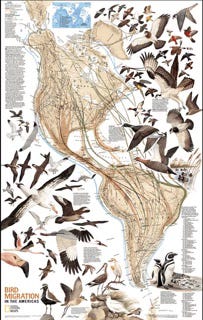
National Geographic bird migration map that makes the very messy
paths of migration visible in a stunning way.
Each new map I added to the wall sparked a new interest. I dreamed of following birds during migration (spoiler: I did for a decade), imagined the vibrant culture existing within the tight infrastructure lines of Copenhagen, the population axe blade in the ocean that is Singapore, and the loopy drawl of Ulaanbataar’s streets floating among the empty space of the Mongolian steppe. What ecosystems and animals thrived where? What spirits dwelled at the topmost layer of a mountain topo map in that oblong crowning shape? How would these unknown places in the world ever come to connect to my one, solitary, existence? If I couldn’t visit all the places, at the very least I could fictionally teleport there.
At the time, the aughts, life was still lived mostly offline, and I was very into the idea that mapping my existence on paper was a good method of bringing my young life into focus. I had learned the skill of “life mapping” and would use it to decide what I wanted to do next in my life. I was also often mapping neighborhoods in my mind as I biked across Portland, considering how I might fold them into a short story.
At night I would sometimes stop my bike in the middle of a bridge crossing the Willamette River to consider each life lived within the pinpoint car headlights moving over the nearby highway. The lights shifted through the dark, a diamond-encrusted serpent making its way through the city. The lens of our rainy streets blurred, and beams ran together into a stream of human existence that gave me some perspective on how small I truly was. A pinpoint of light in the shifting prism of human persistence. All of it connected.
Make Connections
Speaking of connected, back when I was an eleven year-old kid living on the coast of Spain in Alicante, I came up with an image to explain my developing understanding of human interconnectivity that is kind of silly, but cute. As I walked my skinny, tanned, kid frame through the streets like a fawn that has not quite found her footing, I imagined every person I passed by to have an infinite roll of toilet paper attached to their backs. As people bustled along the dusty streets of Alicante their toilet paper tails connected with the other human trails walking those paths. Street dogs roamed in packs, little threads trailing behind them as a frayed rope. The paper wove itself into a fabric of our shared experience throughout history. The TP of time itself. I soon discovered that access to this tapestry could also be found in maps.
I’m pretty sure the entwined threads image came to me because of one of my favorite childhood picture books, The Lace Snail by Betsy Byers. It’s now out of print, but is basically about a snail who suddenly makes lace instead of slime and finds herself working overtime to make parachutes and outfits for all the other greedy little forest-dwelling animals. She exhausts herself making fashionable outfits and parachutes out of lace. In hindsight, the narrative is clearly about the unpaid labor of motherhood and how it saps our life force until we aren’t useful anymore, at which point we stop making lace and presumably just shrivel up and die. It’s about patriarchal expectations that drain women of their creative force. But when I was a kid, it was simply a quaint, melancholy, tale about a snail who makes pretty lace out of her butt until she just. can’t. anymore. And then she goes off with a sigh and the book ends. In my imagination she clearly went off to die alone. That macabre interpretation was rooted in the outcomes of my other reading at the time (see The Rainbow Goblins, Pearl and the Amazing Bone). Because picture books published in the 70’s did not veer away from imminent mortality, now, did they?
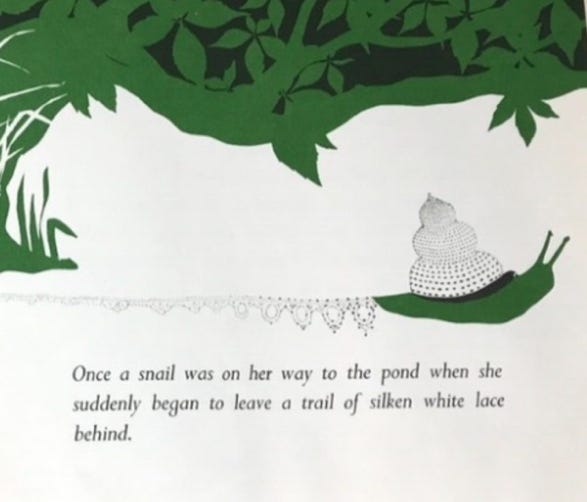
The Lace Snail before she was bombarded by requests by forest creatures for free samples of her work like a struggling artist on Tik Tok.
Banish the Ghosts
But back to the toilet paper. This truly goofy metaphor was a profound moment for my young self as I grappled to understand the way humans weft and wove their lives together throughout history. Our family apartment for the year in Alicante was nestled at the base of a castle fort called Castillo de Santa Barbara built in the 9th century. You could reach a broom handle out the back of the apartment laundry room and touch the rock face, look up the crumbling Mount Benacantil, and see the castle resting on top of the cliff.
Many, many, strange and ghostly things happened in this apartment at the base of the Castillo de Santa Barbara. Doors locked and unlocked themselves without keys, my mom was tossed around during sleep, a heavy being sat on my dad’s chest one day as he napped, and I famously asked my mom “who’s the man in the hallway?” Dear reader, there was no man in the hallway. But this perhaps is a (ghost) story for another time.
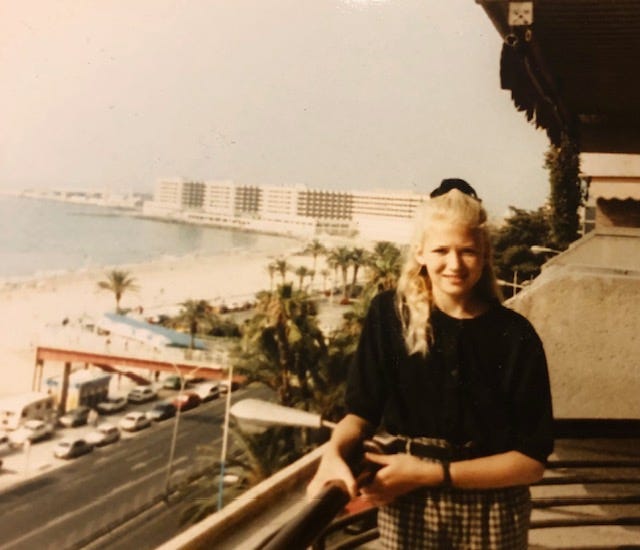
Clutching the railing of my Alicante apartment so an unknown presence doesn’t fling me down onto the highway.
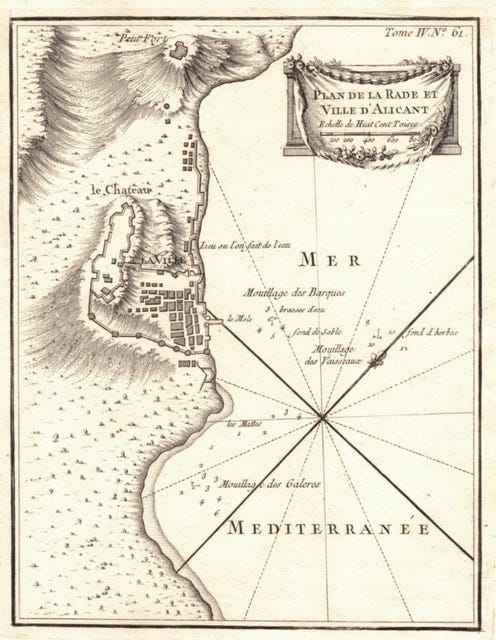
17th century map of Alicante. Quaint and quite conquerable, apparently.
As shown on the maps, Alicante lies on the Costa Blanca, notoriously a barbary pirate target in the 16thand 17th centuries. The pirates disrupted trade and pillaged all along the coast. There was some speculation among my family members as to whether the aggressively present specters flowing in and out of our house like the trade winds were pirates. That framework helped us feel like the full-on haunting happening to us was merely the shenanigans of the famous ghost pirates Captain Jack Ward or the Barbarrossa Brothers.
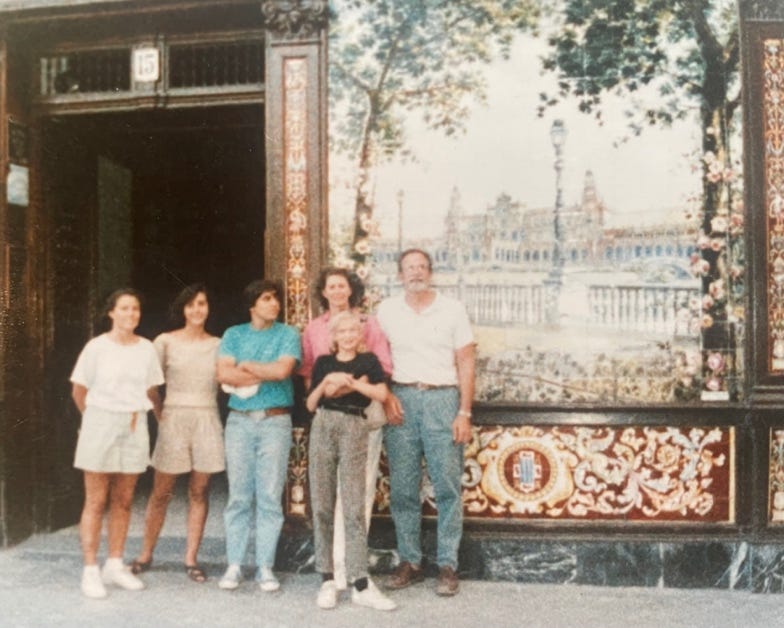
11yo me, my Mom, and Dad in Spain. I think these are real people next to us but who knows. You can see them, right?
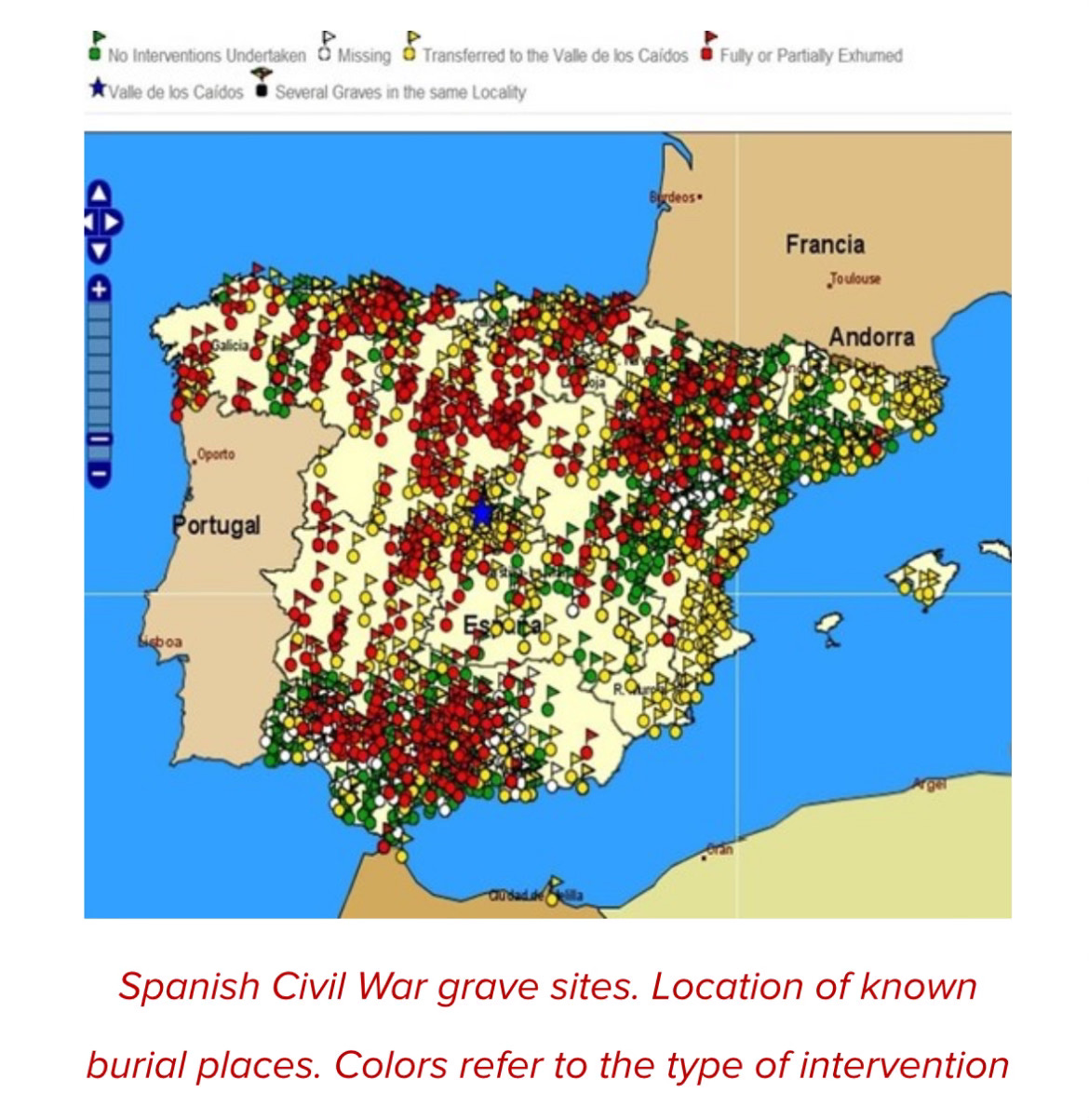
But then, much later in life, I would discover that the more recent history of the castle was far more disturbing than pirates. The Castillo Santa Barbara, only forty-some years before we lived there in the 1990’s, had been the site of one of Franco’s 200-300 prison concentration camps operating between 1939-1947 all across Spain. About a half million people (political dissidents, Romani, homosexuals, artists and separatists, Republicans, the poor) were moved through the camps. Many did not emerge.
Franco’s imprisonment of this population during and after the Spanish Civil War between the elected Popular Front Republicans and Franco’s Nationalist rebels was an iteration of similar situations throughout history; after a brutal coup the losing side is imprisoned by the totalitarian powers that be. It is also, unfortunately, one that reflects to our current political climate in this country and in Gaza—the already disenfranchised becoming scapegoated, imprisoned, and isolated so they don’t continue to rise up. And then, in the process of subjugation and suppression, many of the scapegoats are killed or disappeared.
Learn to Skate, Metaphorically and Physically
Of course, I didn’t fully grasp all this when I was eleven years old living in Spain. But what I did know was that was suddenly and forcefully my first great experience of sadness, nee depression, had descended into my chest. My mother, always intuitive and attentive to the subtle needs of others (much like the lace snail herself) bought me a pair of roller skates as a surprise and laid them on my bed. When I came home from public school where one of my Romani classmates was missing several fingers to make her a better beggar and another informed me she couldn’t have a playdate with me because her family was squatting, I burst into tears and hugged my mom. The kaleidoscopic enormity of life had been building in my body and my small frame was feeling ready to burst into sadness confetti.
My skates firmly in place, I went out to explore the red and white marble paseo that wound along the Mediterranean coastline. The wind in my hair and the ghosts at my back, I discovered the act of moving your legs faster than your melancholy. I befriended one of the African merchants selling leather bracelets and would visit him daily and ask about his family in West Africa (he missed them enormously), chatted with abuelas on the benches, and swam in the Mediterranean.
One day while swimming solo I encountered a dark form ascending from the depths below me that completely freaked me out until I learned from the news that evening that it was a rare, visiting whale shark in the harbor. That evening I was alive in my living room, vibrating, as the newscaster spoke in Spanish about the mysterious marine visitor.
And just like that, I had firmly planted myself in the land of the living and what these encounters did for me was loosen my heart from the chains of sadness. Every day as I moved forward through wind and water I was freed from the heaviness haunting my being by learning about other lives, both human and animal, currently being lived. Life is for the living, and all that. Tropes are tropes for good reason, sometimes.
Map Out the Life You Want to Live
Back in Portland in my studio apartment I remembered touching the castle cliff with the broom and drew a red line of thread connecting the map of Spain at the center of my collage wall upward to a map of Patagonia, Argentina. There had also been concentration camps there during the Dirty War. Death squads hunted down dissidents and people were disappeared by the brutal civic-military dictatorship in the 1970’s. But the novel that contained a bit of that history would not be written by me until much later. It was time to move on. I peeled the map of Spain from the wall, along with the rest of the collaged maps and put them in a box.
I moved out from that tiny apartment, tossed some ripped pieces that were unsalvageable, waved one final goodbye to the bored felons across the way, and folded the remaining maps into my stuff to store in my parents’ basement. Over the next five years I would travel Europe, live and work in New York as a science writer, then move to Seattle to get my MFA in creative writing at University of Washington.
Throughout my movement, that love for maps continued and evolved. So much information can be gleaned from them and worlds can be brought to life from their two dimensional form. I also regularly used my “life mapping” skill to adjust and tweak the trajectory of my own life. I made a drawing of my summer one year in Seattle in cartoon form. As I earned my graduate degree in writing, I started teaching undergraduate composition at University of Washington and incorporated my love of mind maps into my teaching style to help students map and structure their essays and fiction.
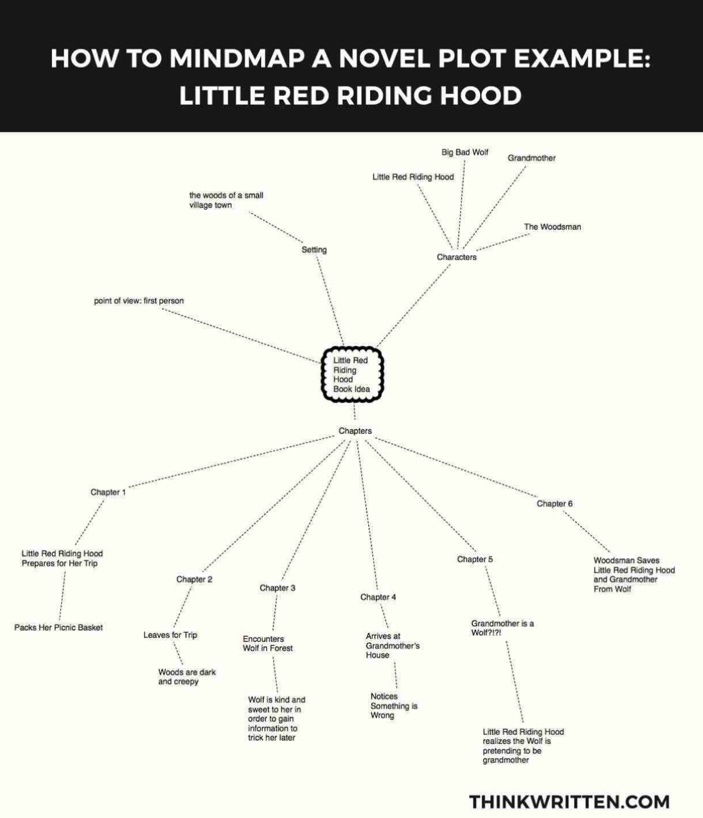
As a grad student I learned how to let a research reverie take hold of me like a ghostly possession. The joy of jumping in with both feet into a new river of knowledge took over. I let the flow of information toss me around and pull me in and out of emotional throes as I researched mythology and folklore, historical dictatorships, natural ecosystems, magical realism, experimental literary structures, and fables. My being expanded as these threads tied me to the world in a way that would help to concrete my sense of belonging as a single point in the vast wilderness of humanity. I persisted and moved in my creative self, spectres be damned.
Part II of this hermit crab essay “Writing the Unknown” forthcoming:
Research and other Side Quests